OpenHealthcare.org · Care note
You’re a trillionaire
An academic poem about the trillions of cells that make us—and the care we deserve.
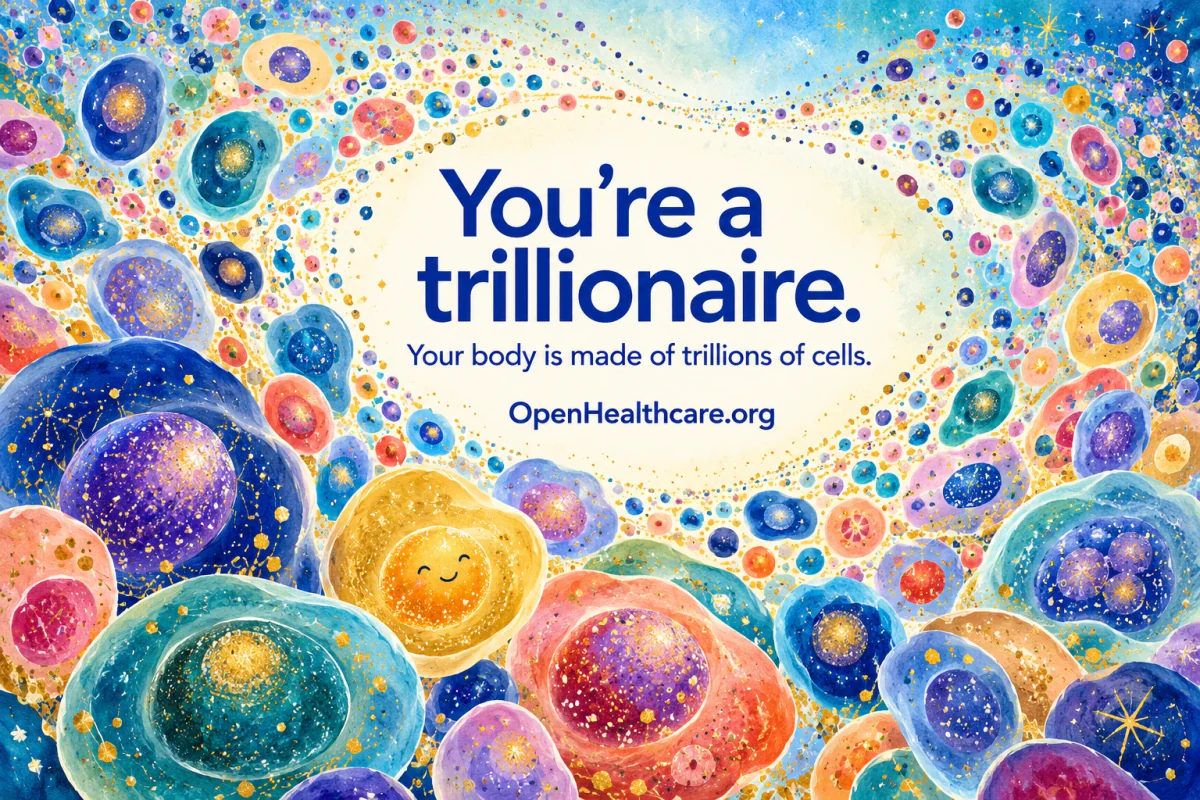
Your body contains trillions of human cells. This poem pairs that scientific scale with a quieter question: how might wonder change the way we regard ourselves? [1, 2]
Observation
Hold out your hand.
A familiar outline.
Within that small horizon,
life exceeds the scale
at which we usually look.
Census
To approach the number,
researchers gathered measurements—
tissue by tissue,
type by type—
until the familiar body
opened into trillions. [1]
Proportion
Blood cells dominate the count. [1, 2]
Mass tells another story:
muscle and fat hold much
of the cellular weight. [1]
Even within one body,
abundance has more than one measure.
Time
Some cells are replaced quickly;
others remain for years. [3]
A living body keeps
more than one kind of time.
A different kind of wealth
Call it a fortune, if you like:
a wealth beneath the visible,
a gathering too vast
to meet one cell at a time.
You’re a trillionaire.
The unit is life.
Beyond the measurement
Yet the count is not a price.
You are worthy of care
before the first number
is written down.
On the page, one golden cell smiles.
That smile belongs to art.
The tenderness it asks of us
can belong to the way
we meet ourselves.
Research notes
- How many cells? Hatton and colleagues estimated approximately 36 trillion cells for a 70 kg adult male reference body, 28 trillion for a 60 kg adult female reference body, and 17 trillion for a 32 kg, 10-year-old child. Their 2023 synthesis drew on more than 1,500 published sources. These are model-based estimates, not individualized measurements or universal totals. Blood cells dominate cell number; muscle and fat dominate cellular biomass. [1]
- Why say trillions rather than one exact number? Sender, Fuchs and Milo estimated about 30 trillion human cells in a 70 kg reference adult male in 2016. Different studies use different inputs and counting conventions; both support the scale of trillions. The totals discussed here concern human cells, not an added bacterial-cell tally. [2]
- What does renewal mean? NIH’s National Institute of General Medical Sciences describes widely differing cell lifetimes: many blood and intestinal-lining cells turn over quickly, while other cells persist for years or longer. This does not mean the whole body renews on a single timetable. [3]
“Trillionaire” is a poetic metaphor for cellular abundance. The smiling cell is artistic personification. Neither is a measure of health, human worth, or a promise of healing.
References
- Hatton IA, Galbraith ED, Merleau NSC, Miettinen TP, Smith BM, Shander JA. The human cell count and size distribution. Proceedings of the National Academy of Sciences 2023;120(39):e2303077120. https://doi.org/10.1073/pnas.2303077120
- Sender R, Fuchs S, Milo R. Revised Estimates for the Number of Human and Bacteria Cells in the Body. PLOS Biology 2016;14(8):e1002533. https://doi.org/10.1371/journal.pbio.1002533
- Crowley R. Cells by the Numbers. National Institute of General Medical Sciences, National Institutes of Health September 25, 2024. https://nigms.nih.gov/biobeat/2024/09/cells-by-the-numbers-2
References checked October 24, 2026.